
What Our ATI TEAS 7 Study Guide Covers
Our ATI TEAS test study guide covers everything you need to know for the exam. We broke our study guide down by each TEAS subject:
- Math
- Science
- Reading
- English and Language Usage
Use this guide as your starting point. It will help you better understand what is on the exam, what concepts to focus on, where to focus your study time, and how to prepare section by section.
Feel free to test yourself with TEAS practice questions at any point while using this guide.
The Four Sections on the TEAS 7 Exam
There are four sections on the TEAS 7 exam. Each section is given separately and counts towards your final score.
It is important to understand each section (and the sub-topics) before we dive into our study guide.
Math (38 Questions, 57 Minutes)
The math section includes 38 questions with a 57 minute time limit. The 2 sub-topics tested on this section are:
- Numbers and Algebra
- Measurement and Data
Science (50 Questions, 60 Minutes)
The science section includes 50 questions with a 60 minute time limit. The 4 sub-topics tested on this section are:
- Human Anatomy and Physiology
- Biology
- Chemistry
- Scientific Reasoning
Reading (45 Questions, 55 Minutes)
The reading section includes 45 questions with a 55 minute time limit. The 3 sub-topics tested on this section are:
- Key Ideas and Details
- Craft and Structure
- Integration of Knowledge and Ideas
English and Language Usage (37 Questions, 37 Minutes)
The English and Language Usage section includes 37 questions with a 37 minute time limit. The 3 sub-topics tested on this section are:
- Conventions of Standard English
- Knowledge of Language
- Using Language and Vocabulary in Writing
What to Study in Each TEAS Section
Each TEAS section covers a different set of skills. The best way to study for this exam is to focus on one section at a time and break each section into smaller parts.
We have split our TEAS exam study guide below into sections and easily digestible topics.
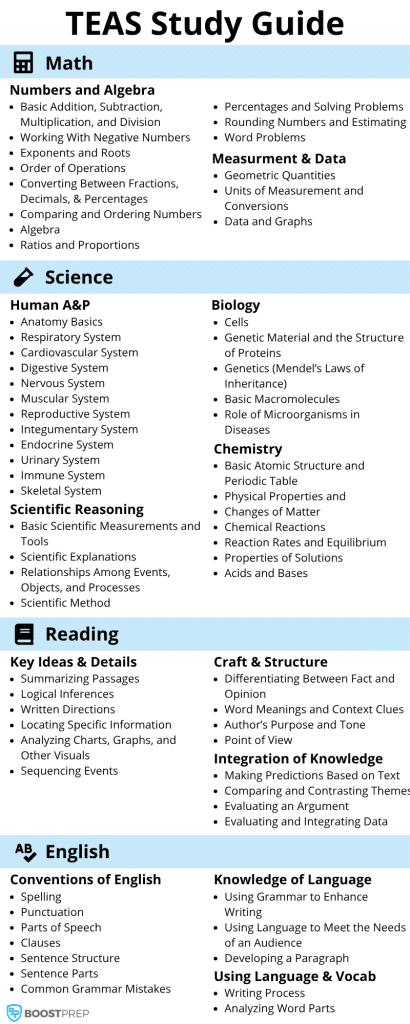
TEAS Math Topics
The TEAS math section is split into 2 sub-topics which are numbers and algebra & measurement and data.
Here are the concepts you should study for TEAS math:
Numbers and Algebra
- Basic Addition, Subtraction, Multiplication, and Division
- Working With Negative Numbers
- Exponents and Roots
- Order of Operations
- Converting Between Fractions, Decimals, & Percentages
- Comparing and Ordering Numbers
- Algebra
- Ratios and Proportions
- Percentages and Solving Problems
- Rounding Numbers and Estimating
- Word Problems
Measurement and Data
- Geometric Quantities
- Units of Measurement and Conversions
- Data and Graphs
You can use our TEAS math study guide for more information on each of these topics.
TEAS Science Topics
The TEAS science section is split into 4 sub-topics which are human anatomy and physiology, chemistry, biology, and scientific reasoning.
Human Anatomy and Physiology
- Anatomy Basics
- Respiratory System
- Cardiovascular System
- Digestive System
- Nervous System
- Muscular System
- Reproductive System
- Integumentary System
- Endocrine System
- Urinary System
- Immune System
- Skeletal System
Chemistry
- Basic Atomic Structure and Periodic Table
- Physical Properties and
- Changes of Matter
- Chemical Reactions
- Reaction Rates and Equilibrium
- Properties of Solutions
- Acids and Bases
Biology
- Cells
- Genetic Material and the Structure of Proteins
- Genetics (Mendel’s Laws of Inheritance)
- Basic Macromolecules
- Role of Microorganisms in Diseases
Scientific Reasoning
- Basic Scientific Measurements and Tools
- Scientific Explanations
- Relationships Among Events, Objects, and Processes
- Scientific Method
You can use our TEAS science study guide for more information on each of these topics.
TEAS Reading Topics
The TEAS reading section is split into 3 sub-topics which are key ideas and details, craft and structure, and integration of knowledge and ideas.
Key Ideas and Details
- Summarizing Passages
- Logical Inferences
- Written Directions
- Locating Specific Information
- Analyzing Charts, Graphs, and Other Visuals
- Sequencing Events
Craft and Structure
- Differentiating Between Fact and Opinion
- Word Meanings and Context Clues
- Author’s Purpose and Tone
- Point of View
Integration of Knowledge and Ideas
- Making Predictions Based on Text
- Comparing and Contrasting Themes
- Evaluating an Argument
- Evaluating and Integrating Data
You can use our TEAS reading study guide for more information on each of these topics.
TEAS English and Language Usage Topics
The TEAS English and language usage section is split into 3 sub-topics which are conventions of standard English, knowledge of language, and using language and vocabulary in writing.
Conventions of Standard English
- Spelling
- Punctuation
- Parts of Speech
- Clauses
- Sentence Structure
- Sentence Parts
- Common Grammar Mistakes
Knowledge of Language
- Using Grammar to Enhance Writing
- Using Language to Meet the Needs of an Audience
- Developing a Paragraph
Using Language and Vocabulary to Express Ideas in Writing
- Writing Process
- Analyzing Word Parts
How to Use This TEAS Test Study Guide
We recommend you use this complete study guide to get an idea of what concepts and topics you should focus on for each section of the exam.
If there are concepts you are comfortable with, you can skip them. Try to focus your time on the concepts you are unfamiliar with.
You can take a deeper dive into each section of the exam with our subject specific study guides (linked in each section above).
If you want a complete study solution, consider using our TEAS prep course, which includes in-depth study guides for every concept listed above (and more). It also includes video lessons, full-length exams, flashcards, and more.
