
What the TEAS Science Section Covers
The science section of the ATI TEAS 7 exam consists of 50 total questions with a 60-minute time limit. Of the 50 total questions, 44 are scored.
Science is the largest of the exam’s four sections and covers the following sub-topics:
- Anatomy & Physiology: 18 Questions
- Biology: 9 Questions
- Chemistry: 8 Questions
- Scientific Reasoning: 9 Questions
You can take our free TEAS science practice test if you would like to test your knowledge and see how you do.
TEAS Science Study Guide
Preparing for science becomes more manageable when you study each sub-topic separately. The four sub-topics cover different knowledge and require different study strategies.
Review each of the sub-topics in our TEAS study guide below.
Sub-Topic #1: A&P
Anatomy and physiology is the largest sub-topic tested. There will be 18 scored A&P questions. This area focuses on the structure and function of the human body. You will be asked about major body systems and how those systems work.
Here are the concepts you should study for the A&P portion of TEAS science:
TEAS Anatomy & Physiology
- Anatomy Basics
- Basic A&P Terms
- Directional Terms
- Body Planes
- Respiratory System
- Basic Functions of the Respiratory System
- Basic Structure of the Respiratory System
- Gas Exchange
- Gas Transport
- Cardiovascular System
- Basic Functions of the Cardiovascular System
- Basic Structure of the Cardiovascular System
- Blood Flow Through the Cardiovascular System
- Digestive System
- Basic Functions of the Digestive System
- Basic Structure of the Digestive System
- Digestive Enzymes
- Nervous System
- Nervous System Terminology
- Basic Functions of the Nervous System
- Basic Structure of the Nervous System
- Neurons
- Brain
- Ventricles
- Spinal Cord
- Meninges
- Muscular System
- Basic Functions of the Muscular System
- Basic Structure of the Muscular System
- Reproductive System
- Female Reproductive System
- Male Reproductive System
- Integumentary System
- Basic Functions of the Integumentary System
- Basic Structure of the Integumentary System
- Endocrine System
- Basic Functions of the Endocrine System
- Basic Structure of the Endocrine System
- Endocrine System and Homeostasis
- Common Hormones
- Urinary System
- Basic Functions of the Urinary System
- Basic Structure of the Urinary System
- Immune System
- Basic Functions of the Immune System
- First Line of Defense
- Second Line of Defense
- Third Line of Defense
- Skeletal System
- Basic Functions of the Skeletal System
- Basic Structure of the Skeletal System
For a detailed breakdown of each of these topics, review our TEAS A&P study guide.
Sub-Topic #2: Biology
Biology accounts for 9 scored questions. This area focuses on foundational life science concepts.
Here are the concepts you should study for the biology portion of TEAS science:
TEAS Biology:
- Cells
- Hierarchical Organization of the Body
- Cell Structure and Function
- Mitosis and Meiosis
- Genetic Material and the Structure of Proteins
- Chromosomes, Genes, DNA, and RNA
- Transcription and Translation
- Genetics (Mendel’s Laws of Inheritance)
- Dominant and Recessive Traits
- Inheritance
- Punnett Squares
- Basic Macromolecules
- Role of Microorganisms in Diseases
For a detailed breakdown of each of these topics, review our TEAS biology study guide.
Sub-Topics #3: Chemistry
Chemistry consists of 8 scored questions. This area focuses on basic chemical concepts like atomic structure, periodic table, and physical and chemical properties.
Here are the concepts you should study for the chemistry portion of TEAS science:
TEAS Chemistry
- Basic Atomic Structure and Periodic Table
- Physical Properties and Changes of Matter
- Chemical Reactions
- Reaction Rates and Equilibrium
- Properties of Solutions
- Acids and Bases
For a detailed breakdown of each of these topics, review our TEAS chemistry study guide.
Sub-Topic #4: Scientific Reasoning
The remaining 9 scored questions assess scientific reasoning. This area focuses on your ability to think like a scientist. You will be asked to interpret data, identify variables, and evaluate experiments.
Here are the concepts you should study for the scientific reasoning portion of TEAS science:
TEAS Scientific Reasoning
- Basic Scientific Measurements and Tools
- Scientific Explanations
- Relationships Among Events, Objects, and Processes
- Scientific Method
For a detailed breakdown of each of these topics, review our TEAS scientific reasoning study guide.
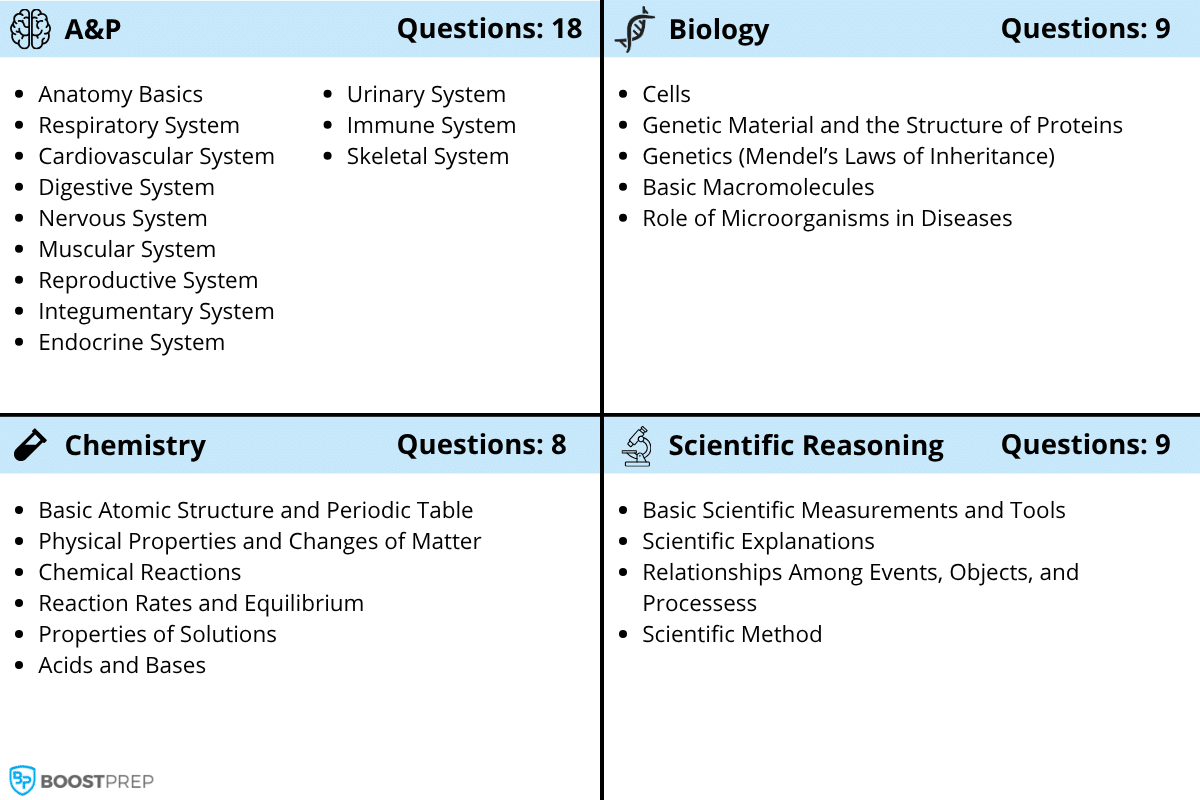
TEAS 7 Science Blueprint
The science section is one of the harder sections on the TEAS 7 exam. Knowing what to expect before going into the exam will be very beneficial for you.
Number of Questions and Time Limits
There will be 50 total questions on the exam. Only 44 of those questions will be scored. You will have 60 minutes to complete the section.
- Number of Questions: 50
- Number of Scored Questions: 44
- Time Limit: 60 Minutes
To make sure you finish the section on time, try to spend about 1 minute per question. Some questions may be quick and easy, while others may require a bit more time to answer. Aiming for 1 minute per question will keep you on track.
How the 44 Scored Questions are Distributed
The scored science questions are divided across the four sub-topics.
| Science Sub-Topic | Scored Questions | Approximate Exam Weight |
| Human Anatomy & Physiology | 18 | 41% |
| Biology | 9 | 20% |
| Chemistry | 8 | 19% |
| Scientific Reasoning | 9 | 20% |
| Total Science | 44 | 100% |
The table above is important because it shows you the breakdown of each sub-topic. We can see that anatomy and physiology plays a much larger role in TEAS science than the other sub-topics.
How to Study for the TEAS Science Section
We recommend starting with a diagnostic exam. You can take our complete TEAS practice exam to get started. We offer a diagnostic exam with questions from all subjects or a science specific exam you can take.
After you complete your diagnostic exam, take some time to review your results. If you take the science specific exam, see which sub-topics you struggled the most with.
For example, if you struggled with A&P but scored fine in chemistry, biology, and scientific reasoning, make sure to spend extra time studying A&P.
You can also use the BoostPrep TEAS prep course to study for the science section. We offer the following in our course:
- 2,400+ Practice Questions
- 28 Full-Length Exams
- Complete Prep Course with 200+ Modules
- Video Lessons
- Custom Exam Builder
- Flashcards
- and More
