
TEAS Chemistry Breakdown
TEAS chemistry is one of the four sub-content areas tested on the TEAS science exam. Chemistry accounts for 8 of the 44 scored questions on the science exam.
You will need to be familiar with the following concepts for the chemistry questions:
- Basic Atomic Structure and Periodic Table
- Physical Properties and Changes of Matter
- Chemical Reactions
- Reaction Rates and Equilibrium
- Properties of Solutions
- Acids and Bases
Use our TEAS chemistry study guide below to review these key concepts. We cover the most important and high-yield concepts you need to know.
If you want to answer practice questions on these concepts, visit our TEAS practice exam hub.
TEAS Chemistry Study Guide
Review each of the concepts below to ensure you do well on the chemistry sub-content area of the TEAS science exam.
Basic Atomic Structure and Periodic Table
Basic Atomic Structure
All matter consists of particles called atoms. Atoms are the smallest unit of matter that retains all of the chemical properties of an element.
Atoms have two regions:
- Inner Region (Atomic Nucleus): The small inner atomic nucleus (containing neutrons and protons)
- Outer Region: The larger outermost region that holds electrons in orbit.
Subatomic particles are the building blocks of atoms, which in turn make up all matter. The three primary types of subatomic particles are:
- Protons: Determine the atomic number of an element, which defines what element an atom is.
- Neutrons: Help stabilize the nucleus by balancing the repulsive forces between positively charged protons.
- Electrons: Involved in chemical reactions and bonding between atoms. The number and arrangement of electrons in an atom’s outermost shell determine its chemical properties.
| Particle | Charge | Mass (amu) | Location |
| Proton | 1 | 1 | Nucleus |
| Neutron | 0 | 1 | Nucleus |
| Electron | -1 | 0 | Orbitals |
Periodic Table
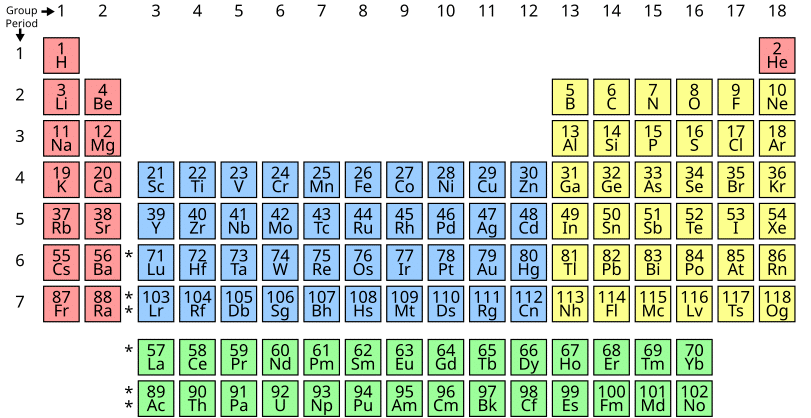
Each element is a unique substance identified by the number of protons, or positive particles, in its nucleus.
These elements are arranged on the periodic table based on their structures and properties. There are 118 total elements.
Some components of the periodic table you should be familiar with are:
- Atomic Number: Elements are arranged by their atomic number (number of protons).
- Periods: The rows of the table are periods. Periods signify elements with the same number of electron shells.
- Groups: The columns of the table are groups. Groups signify similar chemical properties due to having the same number of valence electrons.
- Atomic Symbol: The abbreviation chosen to represent the element.
- Atomic Mass: The total mass of a single atom, mostly made up of its protons and neutrons.
Physical Properties and Changes of Matter
Mass, Volume, and Density Relationships
- Mass: Measures how much matter an object contains.
- Mass = Density × Volume
- Volume: Measures how much space that matter occupies.
- Volume = Mass ÷ Density
- Density: A property that depends on both mass and volume, and it helps explain why materials float or sink in fluids. Denser substances will sink, and less dense substances will float.
- Density = Mass ÷ Volume
States of Matter
The arrangement and motion of particles determine the properties of each state of matter:
- Solids: Particles have the least kinetic energy. Fixed shape and volume.
- Liquids: Particles have more kinetic energy than solids. Fixed volume, variable shape.
- Gases: Particles have the most kinetic energy of the 3 main states (solids, liquids, and gases). Variable shape and volume.
Physical Changes Between States
Matter can change from the 3 states by adding energy or removing energy.
Heating Changes:
- Melting (solid → liquid)
- Evaporation (liquid → gas)
- Sublimation (solid → gas)
Cooling Changes:
- Freezing (liquid → solid)
- Condensation (gas → liquid)
Chemical Reactions
Chemical Reaction Basics
A chemical reaction is a process in which substances (reactants) interact to form new substances (products) with different chemical properties.
Some common signs of a chemical reaction could include:
- Color Change: Indicates a new substance is formed.
- Temperature Change: Heat is released (exothermic) or absorbed (endothermic).
- Gas Formation: Bubbles or fizzing indicate gas production.
- Formation of a Precipitate: A solid forms when two liquids react.
Valence Electrons and Chemical Reactivity
Valence electrons are crucial in determining an atom’s chemical behavior and reactivity. They are located in the outermost electron shell of an atom.
Atoms with full outer shells are less reactive. Atoms with incomplete outer shells are more reactive (seek to become more stable).
Types of Chemical Bonds
There are 2 main types of chemical bonds:
- Covalent Bonds: Occur when atoms share electrons with each other.
- Ionic Bonds: Occur when one atom transfers electrons to another. These involve a metal and a non-metal and create positively and negatively charged ions.
Chemical Reactions and Equation Basics
Chemical reactions involve the transformation of reactants into products, with the total number of atoms remaining constant. We can use chemical equations to identify reactants.
Reactants are written on the left side of the arrow. Products are written on the right side of the arrow.
Example: 2H₂ + O₂ → 2H₂O
- Reactants: Hydrogen (H₂) and Oxygen (O₂)
- Product: Water (H₂O)
To balance chemical equations, follow these steps:
- Count the number of atoms of each element on both sides.
- Add coefficients to balance the number of atoms.
- Start with the most complex molecule.
- Balance metals, then non-metals.
Reaction Rates and Equilibrium
Factors Influencing Reaction Rates
The 4 main factors that influence reaction rates are:
- Concentration: Higher concentration = More frequent particle collisions.
- Temperature: Higher temperature = More molecular kinetic energy.
- Surface Area: Larger surface area = More contact between reactants.
- Catalysts: Lower activation energy required for reaction.
Chemical Equilibrium
Not all chemical reactions go to completion. Traditionally written reactions (A + B → C) suggest complete conversion. Many reactions are actually reversible.
Chemical equilibrium is a dynamic state where forward and reverse reactions occur simultaneously. The rate of forward reaction equals the rate of reverse reaction.
Catalysts
Catalysts are substances that reduce the activation energy needed for a reaction to occur. Activation energy is the minimum energy required to start a chemical reaction.
Catalysts accelerate reactions that would otherwise be very slow. In living organisms, most catalysts are enzymes, which are proteins that speed up chemical processes in the body.
Properties of Solutions
Important Properties of Water
Water (H2O) has a few important properties that you should understand:
- Water is a Polar Molecule
- Water is Cohesive
- Water is Adhesive
- Water Can Exist in All 3 States
Solvent and Solutions
A solution forms when a solute dissolves in a solvent through a physical process (no chemical changes occur).
Solubility is how well a solute dissolves in a solvent. Solutes are classified as:
- Hydrophilic (Water-Loving): Dissolve easily in water.
- Hydrophobic (Water-Fearing): Do not dissolve well in water but dissolve in fats.
Concentration and Dilution
The concentration of a solution measures how much solute is present in a given quantity of solution.
Dilution occurs when solvent is added to reduce the concentration of solute.
Diffusion and Osmosis
Diffusion is the movement of substances from areas of high concentration to low concentration.
Osmosis is a type of diffusion specific to water. Water moves from areas of high water concentration to low water concentration through protein channels called aquaporins.
Passive transport requires no energy. It follows the concentration gradient (high to low). Diffusion and osmosis are forms of passive transport.
Active transport requires cellular energy. It moves molecules against the concentration gradient (low to high).
Acids and Bases
Acids and Bases Basics
An acid is a substance that increases the concentration of hydrogen ions (H⁺) in a solution, typically having a pH less than 7. Some common examples include:
- Vinegar (Acetic Acid)
- Citrus Fruits (Citric Acid)
- Stomach Acid (Hydrochloric Acid)
A base is a substance that decreases the concentration of hydrogen ions (H⁺) by producing hydroxide ions (OH⁻), typically having a pH greater than 7. Some common examples include:
- Baking soda (Sodium Bicarbonate)
- Soap (Sodium Hydroxide)
The pH Scale
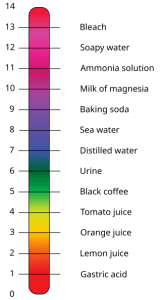
The pH scale measures how acidic or basic a solution is on a scale from 0 to 14.
- pH 0-6: Acidic solutions (lemon juice, vinegar).
- pH 7: Neutral solutions (pure water).
- pH 8-14: Basic solutions (bleach, baking soda).
How to Study for TEAS Chemistry
We recommend you start with our TEAS chem study guide above. Here are some other tips and tricks specific to TEAS chemistry you can use:
- Learn how to use the periodic table.
- Familiarize yourself with protons, neutrons, and electrons.
- Study acids and bases and know some basic examples.
- Review physical vs. chemical changes.
- Know the difference between solids, liquids, and gases.
- Use a TEAS chemistry specific study resource when preparing. Don’t waste your time studying a generic chemistry study resource.
- Use a TEAS chemistry question bank. Question banks are a great way to learn key concepts.
You can use our TEAS prep to prepare for the chemistry section along with all of the other sections on the TEAS exam.
