
TEAS Biology Breakdown
TEAS biology is one of the four sub-content areas tested on the science portion of the TEAS exam. Biology accounts for 9 of the 44 scored science questions.
You will be tested on various biology concepts that include:
- Cells
- Genetic Material and the Structure of Proteins
- Genetics (Mendel’s Laws of Inheritance)
- Basic Macromolecules
- Role of Microorganisms in Diseases
We review each of those concepts in our TEAS bio study guide below. If you want to test your knowledge at any point, answer our TEAS practice questions.
TEAS Biology Study Guide
We broke down each key concept you need to know for the biology portion of the TEAS science exam below. Each concept includes the most important information you should know (high-yield).
Cells
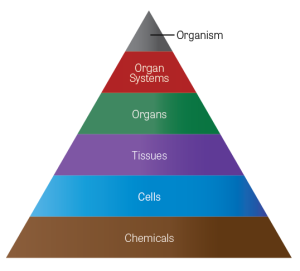
Hierarchical Organization of the Body
The hierarchical organization of the body is:
- Chemicals
- Cells
- Tissues
- Organs
- Organ Systems
- Organism
Cell Structure and Function
Cells are the basic units of life and come in two types:
- Prokaryotes: Simpler, without a nucleus.
- Eukaryotes: Complex, with a nucleus and membrane-bound organelles.
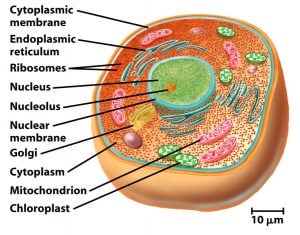
Both prokaryotic and eukaryotic cells share some fundamental structures:
- Cytoplasmic Membrane (Cell Membrane): This flexible boundary controls the entry and exit of substances, providing protection and structure for the cell.
- Cytoplasm: The cytoplasm is the gel-like substance that fills the cell, providing a medium for chemical reactions and supporting the organelles.
- Ribosomes: Ribosomes are responsible for synthesizing proteins, which are essential for cell function. In prokaryotes, ribosomes float freely, while in eukaryotes, they can be found attached to the endoplasmic reticulum (rough ER) or free in the cytoplasm.
Eukaryotic cells also contain additional specialized organelles:
- Nuclear Membrane: A double-layered membrane that controls the flow of materials in and out of the nucleus.
- Nucleus: Holds the cell’s DNA (in the form of chromosomes) and directs cellular activities, acting as the control center of the cell.
- Nucleolus: Found inside the nucleus. This is where ribosomes are assembled before they are transported out to the cytoplasm.
- Mitochondria: Known as the “powerhouse” of the cell, mitochondria produce energy in the form of ATP through cellular respiration.
- Chloroplasts: These organelles carry out photosynthesis, converting light energy into chemical energy for the plant. These are mainly found in plants.
- Endoplasmic Reticulum (ER): The ER assists in the synthesis and transport of proteins (rough ER, with ribosomes) and lipids (smooth ER, without ribosomes).
- Golgi Apparatus: The Golgi modifies, packages, and distributes proteins and other substances throughout the cell.
- Lysosomes: Lysosomes contain digestive enzymes that break down waste materials and cellular debris. They play a key role in cell maintenance by recycling worn-out cell parts.
- Vacuoles: Vacuoles are storage organelles. In plant cells, they are large and help maintain cell structure by holding water, nutrients, and waste products. Animal cells may also have smaller vacuoles for storage and transport of substances.
Mitosis and Meiosis
Mitosis is a type of cell division that results in two identical daughter cells. Each daughter cell has the same number of chromosomes as the parent cell, making it ideal for growth, repair, and asexual reproduction.
Mitosis is a continuous process that occurs in stages:
- Prophase: Chromosomes condense, becoming visible under a microscope. The nuclear membrane begins to break down, and spindle fibers form.
- Metaphase: Chromosomes line up at the cell’s equator, attached to spindle fibers at their centromeres.
- Anaphase: Sister chromatids are pulled apart to opposite ends of the cell by the spindle fibers, ensuring each new cell will receive a complete set of chromosomes.
- Telophase and Cytokinesis: Chromosomes reach the poles, and the nuclear membrane re-forms around each set of chromosomes, creating two nuclei. The cell’s cytoplasm divides, forming two identical daughter cells.
Mitosis produces diploid cells, meaning each daughter cell has the full set of chromosomes. In humans, this is 46 chromosomes (23 pairs). Mitosis is essential for the growth and maintenance of multicellular organisms.
Meiosis is a type of cell division that reduces the chromosome number by half, producing four genetically unique daughter cells.
Meiosis is crucial for sexual reproduction, as it creates haploid gametes (sperm and egg cells) with half the number of chromosomes. The stages of meiosis include two rounds of division, called Meiosis I and Meiosis II:
Meiosis I
- Prophase I: Chromosomes condense, and homologous chromosomes (one from each parent) pair up in a process called synapsis. Crossing over occurs, exchanging genetic material between homologous chromosomes, which increases genetic diversity.
- Metaphase I: Homologous chromosomes line up in pairs at the equator of the cell.
- Anaphase I: Homologous chromosomes (each still consisting of two sister chromatids) are pulled to opposite poles, reducing the chromosome number by half.
- Telophase I and Cytokinesis: The cell divides into two haploid cells, each containing one set of chromosomes.
Meiosis II
- Prophase II: Chromosomes in the two cells condense, and spindle fibers form again.
- Metaphase II: Chromosomes line up individually along the equator in each cell.
- Anaphase II: Sister chromatids are separated and pulled to opposite ends of each cell.
- Telophase II and Cytokinesis: The cells divide, resulting in four unique haploid daughter cells with half the original chromosome number.
Meiosis produces haploid cells, meaning each cell has half the usual number of chromosomes. In humans, this is 23 chromosomes (no pairs).
Genetic Material and the Structure of Proteins
Chromosomes
Chromosomes are found in the nucleus of most cells. Each chromosome contains tightly packed DNA, organized around proteins called histones.
The nucleus of the human body contains 46 chromosomes:
- Half of the chromosomes (23) each come from the mother and father.
- Two of the chromosomes are the sex chromosomes (XY for male and XX for female).
- The other chromosomes are called autosomes (all chromosomes that are not sex chromosomes X or Y).
DNA
DNA carries the instructions needed for an organism’s development, survival, and reproduction. The structure of DNA is a double helix.
DNA is composed of nucleotides which have three important components:
- Nitrogenous Base (A, T, G, C)
- Sugar Molecule (Deoxyribose)
- Phosphate Group
The four nitrogenous bases are:
- Adenine (A)
- Thymine (T)
- Guanine (G)
- Cytosine (C)
These bases are arranged in three letter combinations that make 64 possible combinations called codons.
- Complementary Bases: A always pairs with T and C always pairs with G.
Genes
Genes are the basic unit of genetic material that we inherit from our parents. Genes are specific segments of DNA that encode instructions for making proteins or functional RNA.
Genes are a section of DNA that codes for a specific protein (they are a specific order of codons). Genes can be thousands of codons long.
RNA
RNA is a molecule that helps carry out the instructions encoded in DNA. It plays a key role in protein production within cells. RNA is similar to DNA but has a few key differences:
- Structure: RNA is usually single-stranded, whereas DNA is double-stranded.
- Sugar: RNA contains ribose sugar, while DNA contains deoxyribose sugar.
- Bases: RNA uses uracil (U) instead of thymine (T), so the base pairs in RNA are adenine (A) with uracil (U), and cytosine (C) with guanine (G).
Some types of RNA include:
- mRNA (Messenger RNA): Carries the genetic instructions from DNA to the ribosomes for protein synthesis.
- tRNA (Transfer RNA): Helps assemble amino acids into proteins during translation.
- rRNA (Ribosomal RNA): Part of the ribosome, where protein synthesis occurs.
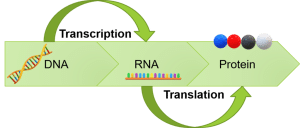
Transcription and Translation
Transcription is the first step in protein synthesis (protein creation), where genetic information in DNA is transcribed into RNA. This process takes place in the nucleus.
Translation is the second step in protein synthesis (protein creation), where the information encoded in mRNA is used to build a protein. This process takes place in the cytoplasm at the ribosome.
Genetics (Mendel’s Laws of Inheritance)
Dominant Alleles
- Dominant alleles are always expressed in the organism’s phenotype (observable traits) if at least one copy of the allele is present in the genotype.
- A dominant allele is represented by a capital letter (A).
- If the genotype includes at least one dominant allele (AA or Aa), the dominant trait will be expressed.
Recessive Alleles
- Recessive alleles are only expressed in the organism’s phenotype (observable traits) when two copies of the recessive allele are present in the genotype (when the individual is homozygous recessive).
- A recessive allele is represented by a lowercase letter (a).
- The recessive trait will only show up in the phenotype if the individual inherits one recessive allele from each parent (the genotype is aa).
Homozygous vs. Heterozygous
Homozygous means that both alleles for a gene are the same:
- Homozygous dominant (AA) = two dominant alleles.
- Homozygous recessive (aa) = two recessive alleles.
Heterozygous means that the alleles for a gene are different:
- Heterozygous (Aa) = one dominant allele and one recessive allele.
Inheritance
Inheritance is the transfer of traits from parents to offspring through genes. There are 2 main types of inheritance:
- Mendelian Inheritance: Refers to the patterns of inheritance that are based on Gregor Mendel’s laws of inheritance.
- Non-Mendelian Inheritance: Refers to patterns that involve more complex genetic interactions than the simple dominant/recessive inheritance Mendel described.
Punnett Squares
Punnett Squares are tools used in genetics to predict the probability of offspring inheriting specific traits. They provide a visual representation of how alleles from each parent combine.
You can follow these steps to set up a Punnett Square:
- Identify the Parent Genotypes
- Draw a Grid
- Label the Grid
- Fill in the Boxes
Here is a simple example:
- Parent Genotypes: Pp × Pp.
- Purple (P) is dominant. White (p) is recessive.
| P | p | |
| P | PP | Pp |
| p | Pp | pp |
Genotypic Ratio = 1 PP : 2 Pp : 1 pp
This ratio means that for every 4 offspring, you would expect 1 to have the PP genotype, 2 to have the Pp genotype, and 1 to have the pp genotype.
Phenotypic Ratio = 3 Purple : 1 White
This ratio means that the offspring will have a 3 out of 4 chance (PP, Pp, Pp) of having the purple phenotype and a 1 out of 4 chance(pp) of having the white phenotype. The purple phenotype is dominant, while the white phenotype is recessive.
Basic Macromolecules
Types of Macromolecules
The 4 main types of macromolecules are:
- Carbohydrates: Provide quick energy and structural support in cells.
- Lipids: Store energy and form cell membranes.
- Proteins: Serve as enzymes, structural components, and signaling molecules.
- Nucleic Acids: Store and transmit genetic information.
Monomers and Polymers
- Monomers: A single, small molecule that can bind with others to form a polymer.
- Polymers: A large molecule made up of repeating monomers.
Dehydration Synthesis & Hydrolysis
- Dehydration Synthesis: The process in which two smaller molecules are joined together to form a larger molecule by removing a water molecule.
- Hydrolysis: The reverse process of dehydration synthesis. Water is added to break down a larger molecule into smaller components.
Role of Microorganisms in Diseases
Microorganisms are tiny living organisms that exist in various environments, including air, water, soil, and inside other organisms. They can be beneficial (in digestion) or harmful (as pathogens).
Main Groups of Pathogenic Microbes
Pathogens are classified into several groups based on their characteristics:
- Viruses: Non-living particles that require a host cell to reproduce.
- Bacteria: Single-celled organisms with a simple structure.
- Protozoans: Single-celled organisms with complex structures.
- Fungi: Multicellular or unicellular organisms.
- Parasitic Animals: Multicellular organisms that live in or on a host.
Infectious vs. Non-Infectious Diseases
The two main disease categories are infectious and non-infectious diseases.
- Infectious Diseases
- Commonly called communicable diseases.
- Caused by pathogens.
- Can spread through direct contact, water, air, or vectors.
- Examples: Tuberculosis, influenza, malaria.
- Non-Infectious Diseases
- Commonly called noncommunicable diseases.
- Not caused by pathogens.
- Can be genetic, environmental, or lifestyle-related.
- Examples: Diabetes, cancer, asthma.
Microscopes
Microscopes can be used in the medical field to identify and research microorganisms. There are 2 main types of microscopes:
- Light Microscopes: Depend on a light source for illumination. There are 6 types of light microscopes:
- Bright-field Microscope: Provides a clear, bright image of stained or pigmented specimens.
- Dark-field Microscope: Highlights specimens against a dark background for increased contrast.
- Phase Contrast Microscope: Enhances contrast in transparent specimens without staining.
- Fluorescence Microscope: Uses fluorescent dyes to visualize specific cell components.
- Confocal Scanning Laser Microscope (CSLM): Produces detailed, 3D images of cells and tissues.
- Differential Interference Contrast (DIC) Microscope: Creates high-contrast, 3D-like images by exploiting differences in light refraction.
- Electron Microscopes: Replace light with electron beams for visualization, achieving much greater magnification and resolution. Require a vacuum, so living specimens cannot be observed. There are 2 types of electron microscopes:
- Transmission Electron Microscope (TEM): Produces highly detailed images of internal cell structures by transmitting electrons through thin specimens.
- Scanning Electron Microscope (SEM): Provides 3D surface images by scanning electrons across the surface of a specimen.
How to Study for TEAS Biology
TEAS biology can appear overwhelming, but it is important to remember that there will only be 9 scored questions from this sub-content area.
When studying biology, try to stick to the basics and learn the high-level concepts. Everything in our guide above is a great place to start. Here are some other tips and tricks to keep in mind:
- Take a diagnostic test and use it as a baseline. This will help you see where you stand.
- Answer questions specifically focused on TEAS bio. Practice questions are one of the best way to learn key concepts.
- Do not get into the weeds. Find a TEAS-specific study program. If you use a generic biology program, you will waste so much time studying things you do not need to know.
We include everything you need to succeed with our complete ATI TEAS 7 prep course.
