
TEAS Reading Sub-Topics
TEAS reading is made up of 3 sub-topics:
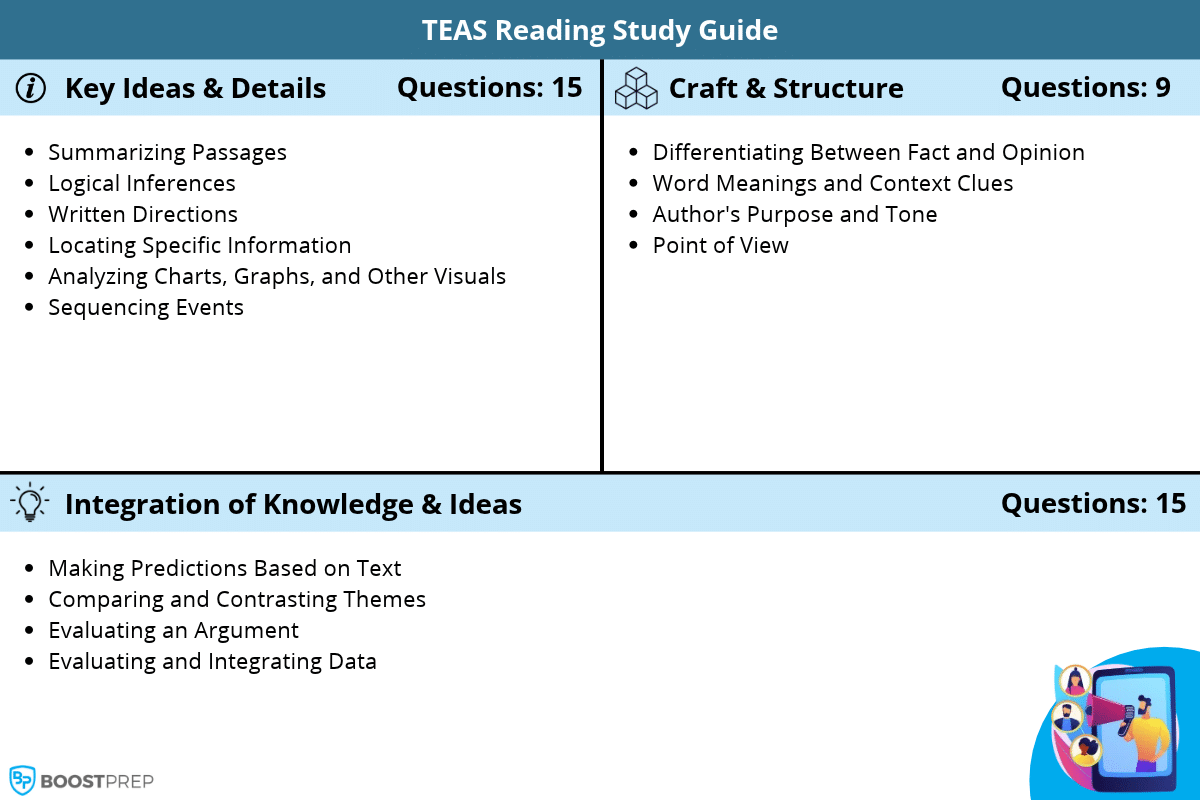
Key Ideas and Details (15 Questions)
- R.1.1: Summarize a multi-paragraph text.
- R.1.2: Make inferences and draw conclusions about a text’s purpose and meaning.
- R.1.3: Demonstrate comprehension of written directions.
- R.1.4: Locate specific information in a text.
- R.1.5: Analyze, interpret, and apply information from charts, graphs, and other visuals.
- R.1.6: Interpret events in a sequence
Craft and Structure (9 Questions)
- R.2.1: Distinguish between fact and opinion to identify misconceptions and biases.
- R.2.2: Interpret the meaning of words and phrases using context.
- R.2.3: Evaluate the author’s purpose in a given text.
- R.2.4: Evaluate the author’s point of view or perspective in a given text.
Integration of Knowledge and Ideas (15 Questions)
- R.3.1: Use evidence from the text to make predictions, inferences, and draw conclusions.
- R.3.2: Compare and contrast the themes expressed in one or more texts.
- R.3.3: Evaluate an argument.
- R.3.4: Evaluate and integrate data from multiple sources across various formats, including media.
You can quiz yourself on these topics by taking our free TEAS test and seeing how you score.
TEAS Reading Study Guide
We have broken down each sub-topic for you below. Our goal is to create easy-to-learn lessons and topics to help you study in the most efficient way possible.
Review all of the lessons and topics in our ATI TEAS reading study guide below.
Sub-Topic #1: Key Ideas and Details
Key ideas and details will have 15 scored questions.
This area of the exam will focus on your ability to grasp the key ideas and details from a passage. The items you should focus on for the key ideas and details sub-topic are listed below.
TEAS Key Ideas and Details
- Summarizing Passages
- Logical Inferences
- Written Directions
- Locating Specific Information
- Analyzing Charts, Graphs, and Other Visuals
- Sequencing Events
Sub-Topic #2: Craft and Structure
Craft and structure will have 9 scored questions.
This area of the exam will focus on things like facts vs. opinions, purpose and tone, and point of view. The items you should focus on for the craft and structure sub-topic are listed below.
TEAS Craft and Structure
- Differentiating Between Fact and Opinion
- Word Meanings and Context Clues
- Author’s Purpose and Tone
- Point of View
Sub-Topic #3: Integration of Knowledge and Ideas
Integration of knowledge and ideas will have 15 scored questions.
This area of the exam will focus on things like making predictions, themes, arguments, and data. The items you should focus on for the integration of knowledge and ideas sub-topic are listed below.
TEAS Integration of Knowledge and Ideas
- Making Predictions Based on Text
- Comparing and Contrasting Themes
- Evaluating an Argument
- Evaluating and Integrating Data
TEAS 7 Reading Overview
The reading portion of the exam will have 45 total questions. Of those 45 questions, 39 are scored. You will have 55 minutes to complete this section of the exam.
- Number of Questions: 45
- Number of Scored Questions: 39
- Time Limit: 55 Minutes
To make sure you stay on track and finish in time, you will want to spend less than 73 seconds (1 minute and 13 seconds) per question. If you start spending more than 73 seconds per question you risk running out of time.
How the 39 Scored Questions are Distributed
The scored reading questions are divided across the three sub-topics:
| Reading Sub-Topic | Scored Questions | Approximate Exam Weight |
| Key Ideas and Details | 15 | 38.5% |
| Craft and Structure | 9 | 23% |
| Integration of Knowledge and Ideas | 15 | 38.5% |
| Total Reading | 39 | 100% |
The table above shows us that all 3 sub-topics are important to study as they all play a role in your final score for TEAS reading.
Reading Passages
The reading portion of the exam will contain reading passages. There is not an official number of reading passages on the exam, but you can expect the following when you encounter a reading passage:
- Passage can include 1-7 questions
- Passage can be academic, a memo, directions, or graphics
- Questions can be multiple-choice, multiple-select, fill-in-the-blank, hot spot, or ordered response
The length of a reading passage will also vary. They are typically 150 to 400+ words. To get a better idea of what a TEAS reading passage looks like, take our free TEAS reading practice test.
How to Study for the TEAS Reading Section
When studying for the TEAS reading portion of the exam, we recommend the following flow:
- Take a diagnostic test. This will help you narrow down which areas you struggle with and help you study more efficiently.
- Take a full-length exam. This will also help give you a better idea of where you stand. It will also help you become more comfortable with the format of the exam (and the reading passages).
- Review key reading concepts. Make sure you are comfortable with key reading concepts like author’s purpose and tone, identifying key ideas and details, etc…
- Take a final mock exam. Before heading into your actual exam, take a final mock exam. This will give you that final “indicator” that you are ready for the real thing.
Our online TEAS 7 prep course includes all of these tools and more:
- 2,400+ Practice Questions
- 28 Full-Length Exams
- Complete Prep Course with 200+ Modules
- Video Lessons
- Custom Exam Builder
- Readiness Indicator
- Flashcards
- and More
