
The TEAS Score System
The TEAS score system is an equated scoring model that reports your performance on the ATI TEAS 7 as a set of percentages from 0% to 100%, which is then combined into a single Adjusted Total Score (composite score).
The Adjusted Total Score calculates your total score from the percentage of the 150 scored questions you answered correctly. The score takes into account difficulty differences between tests.
Your score report will also display the following:
- 4 Content Area Scores
- Sub-Content Area Scores
- Percentile Rank
- Academic Preparedness Level
How the ATI TEAS is Scored
Assessment Technologies Institute (ATI) does not score the TEAS by simply dividing the number of questions you got correct by the total number of scored questions.
TEAS scores are equated, which means that ATI adjusts scores to account for differences in difficulty between different versions of the exam. The adjusted score is designed to make scores comparable across different exam forms.
For more information on the actual exam itself, read our TEAS exam overview.
Raw Score vs. Scale (Adjusted) Score
Your raw score is the number of questions you answered correctly. For example, if you answered 110 questions correctly, your raw score would be 110.
Your adjusted score is the score ATI reports after applying its scoring method. The adjusted score is reported as a percentage.
There is Not Penalty for Guessing
There is no penalty for guessing on the exam. If you are unsure on a questions, you are better off guessing than leaving the question blank.
This is especially important when you are nearing the time limit. A blank question cannot help you. A guessed answer still gives you a chance to earn credit on that question.
The 4 Score Types on Your TEAS Score Report
1. Adjusted Total Score (Composite)
The Adjusted Total Score is your overall TEAS score. This is the most important number on your score report. Many programs use it as the main requirement for admission eligibility.
For example, programs may require a minimum composite score of 60%, 65%, 70%, or higher. Competitive programs may also look for scores above their minimum passing requirements.
2. Content Area Scores
Your content area scores show how you performed in each major TEAS section:
- Math
- Science
- Reading
- English and Language Usage
These content area scores help you see how you scored on the specific sections of the exam.
Some schools may also require minimum section scores.
3. Sub-Content Area Scores
Your sub-content area scores show how you performed in greater detail on the above content areas.
For example, the sub-content area score for the math section would show the following scores:
- Numbers and Algebra
- Measurement and Data
These sub-content area scores are helpful because they show you where you need to improve. You can use these scores to study more efficiently if you need to re-take the exam.
4. Mean and Percentile Rank
You will see a national mean and a program mean score on your report:
- National Mean: Shows the average score among a national group of TEAS test takers.
- Program Mean: Shows the average score among TEAS test-takers from a similar type of program (BSN, ADN, ABSN, etc..).
You will also see a national percentile and a program percentile:
- National Percentile: Shows the percentage of test-takers who scored below you (from a national comparison group).
- Program Percentile: Shows the percentile of test-takers who scored below you (from a program comparison group).
For example, if your national percentile rank is 70%, that means you scored higher than 70% of test-takers in the national comparison group.
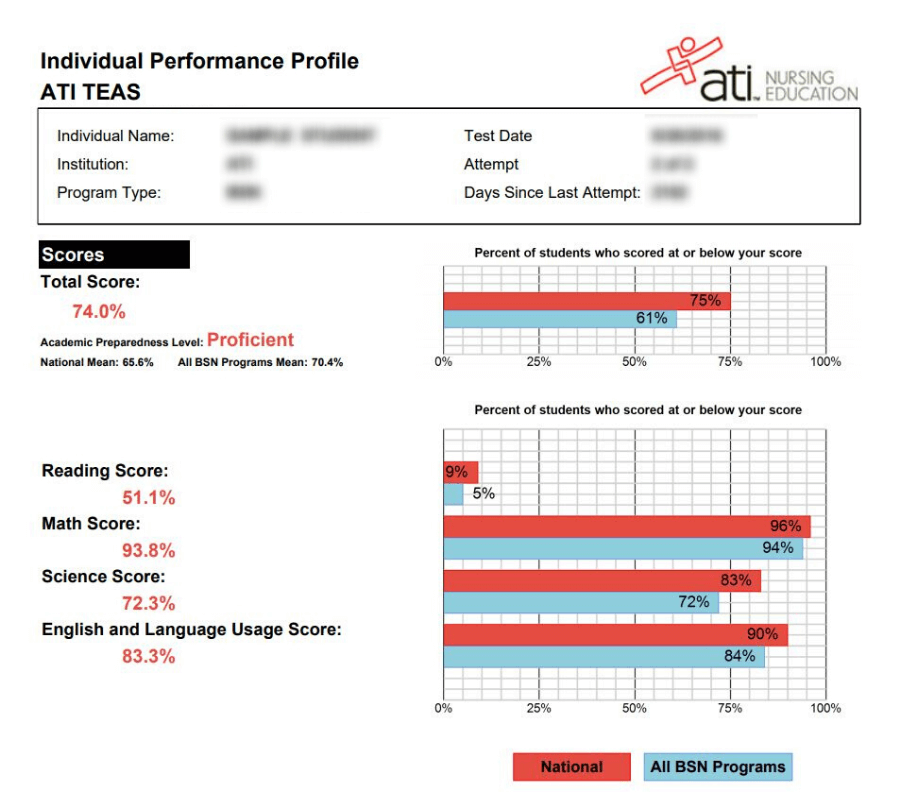
Example TEAS Score Report
The image below shows an example TEAS score report and the different sections of the report.
The most important score on this report is the Total Score in the top left corner.
ATI Academic Preparedness Levels
The Five Levels
ATI groups TEAS performance into Academic Preparedness Levels. These levels describe how prepared a student is for their coursework.
Here are the 5 levels:
| Academic Preparedness Level | Score Range |
|---|---|
| Developmental | 0.0% – 40.7% |
| Basic | 40.7% – 58.0% |
| Proficient | 58.7% – 79.3% |
| Advanced | 80.0% – 91.3% |
| Exemplary | 92.0% – 100.0% |
Developmental and Basic scores generally signal that a student needs additional academic improvement before starting a nursing or allied-health program.
Which Level Most Nursing Programs Expect
Most nursing programs want applicant to score in the proficient range or higher. With that being said, this is not a universal rule as every program sets their own standards.
The safest approach is to check your specific program’s TEAS scoring policy. Make sure to look for the following items:
- Minimum Composite Score
- Required Section Scores
- Accepted Test Dates
- Retake Policy
Why There is No Universal TEAS Passing Score
There is no universal TEAS passing score. Every school / program set their own scoring requirements. ATI creates the exam and score report, but individual schools decide what score they require for admission.
This is why some students may “pass” for one program but not meet the requirements for another program. Your target score should be based on the specific schools you are applying to.
Program Set Minimums vs. ATI Benchmarks
ATI’s Academic Preparedness Levels are only benchmarks that describe general readiness. Your school’s minimum score is the actual admissions requirement you need to meet.
For example, ATI may classify your score as “Proficient”, but your program may still require a higher score for admission. On the flip side, some programs may accept scores that are lower than what another program would consider competitive.
When Section Minimums Override the Composite
Some programs require both a minimum composite score and minimum section scores. If that happens, a strong overall score may not be enough if one section falls below the required cutoff.
For example, a student could have a solid Adjusted Total Score but still miss the program requirement if their science score is too low. Make sure to always check your school or programs TEAS scoring requirements.
How to Read Your TEAS Score Report
The TEAS score report can be overwhelming. We recommend looking at the score report in chunks:
- Adjusted Total Score: This is your total score and the most important number.
- Academic Preparedness Levels: This describes one of the five levels that ATI assigns to you (developmental, basic, etc..).
- Content Area Scores: These are your scores on each section (math, science, reading, English).
- Sub-Content Area Scores: These are your scores on the more granular sub-content areas for each section.
- Percentile Ranks and Mean Scores: These items show you how you did compared to your peers.
When You Get Your Scores and How to Send Them
The amount of time it takes to get your scores back depends on how you took your exam:
- Online: A preliminary score will be displayed as soon as you submit your exam. The official transcript is finalized in 4 business days.
- Paper-Based: Scores can take up to 3 business days to be processed and posted.
- PSI Testing Center: Scores can take up to 3 business days to be processed and posted.
Once your scores are finalized and posted, you can view them via your ATI account.
Before testing, check with you school’s score submission policy. Some schools may require official ATI scores sent directly via ATI, while others may be more relaxed and accept other methods.
Some scores are automatically sent to the schools connected to your account when you register. Some scores may require you to purchase or send the official transcript through ATI.
What Your Score Tells You to Do Next
If your score already meets your program’s requirements, you can focus on submitting your scores and completing the rest of your application.
If your score is close to your target score, but not quite there, review your weakest content areas and take another timed TEAS practice exam. Small improvements in one or two weak areas can get you over the hump.
If your score is far below your target score, consider a complete TEAS prep program to get your score up. Our program includes everything you need (full-length exams, learning content, video content, and more) to get a top score.
