
TEAS Numbers & Algebra Breakdown
TEAS numbers and algebra is one of two sub-content areas tested on TEAS math. It makes up 18 of the 34 scored math questions.
ATI tests 10 concepts on the numbers and algebra portion of TEAS math:
- M.1.1: Convert among non-negative fractions, decimals, and percentages.
- M.1.2: Perform arithmetic operations with rational numbers.
- M.1.3: Compare and order rational numbers.
- M.1.4: Solve equations with one variable.
- M.1.5: Solve real-world problems using one-or multi-step operations with real numbers
- M.1.6: Solve real-world problems involving percentages.
- M.1.7: Apply estimation strategies and rounding rules to real-world problems.
- M.1.8: Solve real-world problems involving proportions.
- M.1.9: Solve real-world problems involving ratios and rates of change.
- M.1.10: Solve real-world situations using expressions, equations, and inequalities.
We break down each of these concepts in a manageable way in our numbers and algebra study guide below.
Want to practice? Use our free TEAS practice questions to start practicing.
TEAS Numbers & Algebra Study Guide
We work through all of the concepts ATI tests on the numbers and algebra section below.
Each concept builds on itself, so make sure you are comfortable with a concept before you move on. Feel free to skip concepts you are already comfortable with.
If you want a more in-depth review for your exam, consider using our ATI TEAS 7 prep course. It includes a complete prep course (200+ modules & video content), 2,400+ practice questions, full-length exams, study tools, and more.
Basic Addition, Subtraction, Multiplication, and Division
Place Value
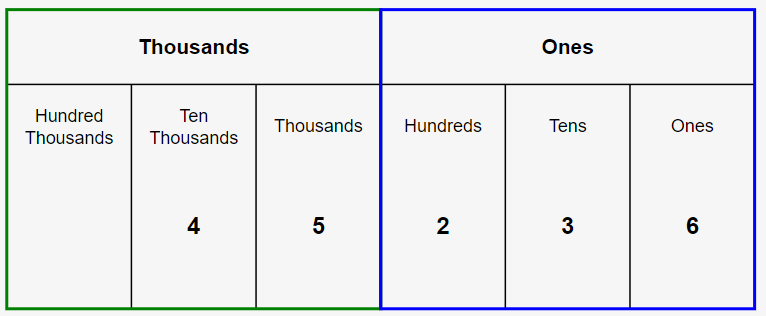
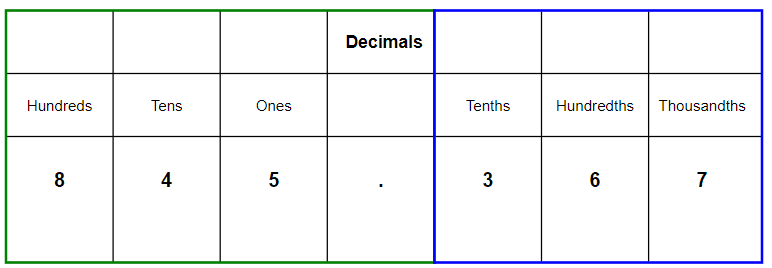
Place value determines the value of a digit based on its position in a number.
For whole numbers, the place value increases from right to left (ones, tens, hundreds, etc.)
For decimals, the place value decreases from left to right (tenths, hundredths, thousandths, etc.)
Addition
Addition combines numbers. It is a way to find the total when you combine two or more values. The sum is the result of an addition problem.
Addition is represented by the + symbol. Use a calculator whenever you can instead of conducting the long addition.
Example: 5 + 5 = 10
Subtraction
Subtraction finds the difference. It is used to determine how much remains when one number is taken away from another.
The difference is the result of a subtraction problem.
Subtraction is represented by the – symbol. Use a calculator whenever you can instead of conducting the long subtraction.
Example: 10 – 7 = 3
Multiplication
Multiplication simplifies repeated addition. It allows you to add the same number multiple times quickly. The numbers being multiplied are called factors, and the result is the product.
Symbols indicating multiplication can include x, *, or numbers next to each other 2(5) = 10. Use a calculator whenever you can instead of conducting the long multiplication.
Example: 10 * 5 = 50
Division
Division splits numbers into equal parts. It is used to divide a number into equal groups or find how many times one number fits into another.
The number being divided is the dividend, the number you divide by is the divisor, and the result is the quotient.
Symbols indicating division can include ÷, /, or \frac{14}{100} .
Use a calculator whenever you can instead of conducting the long division.
Example: 100 ÷ 25 = 4
Fractions
Fraction Introduction
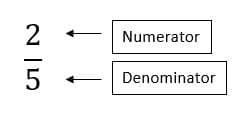
The numerator is the top number in a fraction. The denominator is the bottom number in a fraction.
Reducing Fractions
To reduce a fraction you need to identify the common factors, divide both the numerator and denominator by the common factor, then check for further simplification.
Example: Reduce the fraction \frac{16}{24}
Step 1: List the factors of 16 and 24
16: {1, 2, 4, 8, 16}
24: {1, 2, 3, 4, 6, 8, 12, 24}
Step 2: Find the greatest common factor (8), and divide both the numerator and denominator by 8.
\frac{16 \div 8}{24 \div 8} = \frac{2}{3}
Least Common Denominator
To find the least common denominator you need to identify the denominators, list the multiples, find the common multiples, and then choose the least common denominator (LCD).
Example: Given the fractions \frac{3}{5} and \frac{6}{8} find the least common denominator.
Step 1: List out the first 10 multiples of 5 and 8.
Note: Multiples are the products you get when you multiply a number by whole numbers. In the example below, multiples of 5 are 5 × 1, 5 × 2, 5 × 3, etc..
5: {5, 10, 15, 20, 25, 30, 35, 40, 45, 50}
8: {8, 16, 24, 32, 40, 48, 56, 64, 72, 80}
Step 2: Find the least common multiple in the list. This is 40. When working with fractions, this is called the least common denominator.
Mixed Numbers and Improper Fractions
A mixed number is a type of number that combines a whole number and a proper fraction. An improper fraction is a fraction where the numerator is larger than the denominator.
Example: Change 2\frac{1}{3} to an improper fraction
Step 1: Multiply the whole number by the denominator (3). Then add the numerator (1) to that number.
2 × 3 = 6
6 + 1 = 7
Step 2: Write the improper fraction using the answer from Step 1 (7) as the numerator and the denominator will be 3 (remains the same as the original problem).
2\frac{1}{3} = \frac{7}{3}
Addition and Subtraction of Fractions
When adding or subtracting fractions, you need to have the same common denominator.
To add or subtract fractions, find a common denominator, convert the fractions to have the same common denominator, add or subtract the numerators (top numbers), keep the denominators the same, and simplify.
Example: \frac{2}{3} + \frac{1}{6}
Step 1: Find a common denominator. We can list the multiples of our denominators to find a common one.
3: {3, 6, 9}
6: {6, 12, 18}
We can use 6 as a common denominator.
Step 2: Change 1 or both fractions to have the common denominator.
\frac{2}{3} = \frac{2 \times 2}{3 \times 2} = \frac{4}{6}
\frac{1}{6} = \frac{1}{6}
Step 3: Rewrite the problem, add the numerators, and keep the denominators the same.
\frac{4}{6} + \frac{1}{6} = \frac{5}{6}
Multiplication of Fractions
When multiplying fractions, you do not need to have the same common denominator. You can simply multiply the numerators and the denominators.
Example: \frac{12}{18} × \frac{8}{17}
Step 1: Multiply the numerators and the denominators
\frac{12}{18} × \frac{8}{17} = \frac{96}{306}
Step 2: Simplify
\frac{96}{306} = \frac{48}{153} = \frac{16}{51}
Division of Fractions
When dividing fractions, you do not need to have the same common denominators. You can “multiply by the reciprocal.”
Multiplying by the reciprocal just means flipping the second fraction so the numerator becomes the denominator. You can then change the sign from division to multiplication and solve from there.
Example: \frac{2}{9} ÷ \frac{3}{7}
Step 1: Flip the second fraction and change the sign from division to multiplication
\frac{2}{9} ÷ \frac{3}{7} = \frac{2}{9} × \frac{7}{3}
Step 2: Multiply the numerators and the denominators
\frac{2}{9} × \frac{7}{3} = \frac{14}{27}
Step 3: Simplify
\frac{14}{27} is fully simplified
Working with Negative Numbers
Adding and Subtracting Negative Numbers
Adding and subtracting negative numbers can become confusing. Our biggest piece of advice is to become comfortable with a four-function calculator and use it during your exam.
Example: -8 – (-3) = -5
In this example, we could work it out without a calculator, but we open ourselves up to potential mistakes. When working with negative numbers on TEAS math, use your calculator.
Multiplying and Dividing Negative Numbers
The same goes for multiplying and dividing negative numbers. Use your calculator whenever possible to avoid mistakes.
However, with multiplication and division of negative numbers, there are 2 easy rules you can remember:
- If there is an odd number of negative signs, your answer will be negative.
- If there is an even number of negative signs, your answer will be positive.
You can use these rules to quickly double check your work on the exam.
Exponents and Roots
Exponents
An exponent indicates how many times a base is multiplied by itself.
3² = 3 × 3
Keep these rules in mind when working with exponents:
- Rule 1: Any base to the power of 0 = 1. Except for 0.
- Rule 2: You can add exponents if you are multiplying powers with the same bases.
- Rule 3: You can subtract exponents if you are dividing powers with the same bases.
- Rule 4: You can multiply exponents if you are raising a power to a power.
- Rule 5: When you have a base with a negative exponent, you can make the exponent positive by moving the base to the opposite side of a fraction.
Example: Simplify 4x4y3 ÷ 2x2y
Step 1: Use rule #3 and subtract exponents since we are dividing powers with the same bases:
4/2 = 2
\frac{x^4}{x^2} = x^{4 – 2} = x^2
\frac{y^3}{y} = y^{3 – 1} = y^2
Step 2: Put it all together to get:
2x2 y2
Roots
In the expression \sqrt{25} , the number 25 is called the radicand, and the symbol √ represents the square root.
The square root tells you which number, when multiplied by itself, equals the radicand.
\sqrt{25} = 5 because 5 × 5 = 25.
To add or subtract roots, you need to follow 2 rules:
- Rule 1: The radicands (number under the root sign) must be the same.
- Rule 2: The terms must be the same type of root – square root, cube root, etc…
Example: 3\sqrt{2} + 4\sqrt{2} =
Rule 1 is satisfied as both have the same radicand \sqrt{2} .
Rule 2 is satisfied as both are the same type of root (square root).
We can add the terms to get:
3\sqrt{2} + 4\sqrt{2} = 7\sqrt{2}
To multiply and divide roots, you need to follow one rule:
Rule 1: The terms must be the same type of root – square root, cube root, etc…
Example:
\sqrt{3} \times \sqrt{6} = \sqrt{18}
\sqrt{18} = \sqrt{9 \times 2} = \sqrt{9} \times \sqrt{2} = 3\sqrt{2}
Order of Operations
PEMDAS
The order of operations refers to the order in which we need to solve equations.
We can use the acronym PEMDAS to remember the order:
- Parentheses
- Exponents
- Multiplication
- Division
- Addition
- Subtraction
Example: 4 + -5 × 4 + (5 – 3)2
Step 1: Solve the parentheses.
4 + -5 × 4 + (2)2
Step 2: Simplify the exponent.
4 + -5 × 4 + 4
Step 3: Multiply. There is no division.
4 + -20 + 4
Step 4: Add to find the answer.
-12
Converting Between Fractions, Decimals, and Percentages
Decimals to Fractions
To convert from decimals to fractions you need to identify the decimal, determine the place value, and write as a fraction.
Determining the place value is the most important step:
- Tenths (1 decimal place) = denominator of 10
- Hundredths (2 decimal places) = denominator of 100
- Thousandths (3 decimal places) = denominator of 1,000, and so on.
Example: Change 0.25 to a fraction.
Step 1: Find the place value of the last digit.
0.25 has the last digit in the hundredths place
This means we use a denominator of 100
Step 2: Take the number in the decimal (25) and write it as the numerator. Use 100 as the denominator (step #1).
\frac{25}{100}
Step 3: Reduce the fraction
\frac{25}{100} = \frac{1}{4}
Fractions to Decimals
To convert a fraction to a decimal, all you have to do is divide the numerator by the denominator.
Example: Change \frac{1}{8} to a decimal.
Step 1: Divide the numerator by the denominator.
1 ÷ 8 = 0.125
Decimals and Fractions to Percentages
To change a decimal to a percentage, multiply the decimal by 100 and add the % sign.
Example: Convert 0.20 to a percentage.
Step 1: Multiply 0.20 by 100 and add the percentage sign
0.20 × 100 = 20%
To change a fraction to a percentage, divide the numerator by the denominator to get a decimal. Multiply that decimal by 100 and add the percentage sign.
Example: Convert \frac{7}{8} to a percentage.
Step 1: Divide 7 by 8 to get a decimal.
7 ÷ 8 = 0.875
Step 2: Multiply the decimal by 100 and add the % sign.
0.875 × 100 = 87.5%
Percentages to Decimals and Fractions
To change a percentage to a decimal, divide the percentage by 100.
Example: Convert 28% to a decimal.
Step 1: Divide 28% by 100 and remove the percentage sign
- 28% ÷ 100 = .28
To change a percentage to a fraction, put the percentage over 100. Simplify if necessary.
Example: Convert 25% to a fraction.
Step 1: Put 25 over 100
\frac{25}{100}
Step 2: Simplify the fraction.
\frac{25}{100} = \frac{1}{4}
Comparing and Ordering Numbers
Comparing Quantities
When asked to compare and order quantities, it is typically easiest to convert them all to decimals, and then order and compare them in decimal form.
Example: Place the following numbers in order from least to greatest: \frac{2}{3} , 0.5, -1, 1\frac{1}{8}, -2.5
Step 1: Convert each number to its equivalent decimal form.
\frac{2}{3} = 0.667
0.5 = 0.5
-1 = -1
1\frac{1}{8} = 1.125
-2.5 = -2.5
Step 2: Place them in order from least to greatest. Negative numbers will be on the left if you are starting with the smallest numbers.
We can list all of the numbers from smallest to greatest.
-2.5, -1, 0.5, 0.667, 1.125
Step 3: Change the numbers back to their original form.
-2.5, -1, 0.5, \frac{2}{3} , 1\frac{1}{8}
Algebra
Evaluating Expressions
When evaluating expressions, remember these 3 things:
- Order of operations (PEMDAS)
- Substitution can help us simplify and solve
- Adding like terms can help us simplify and solve
Example: If x = 4, what is the value of x2 + 3x – 1
Step 1: Substitute the number 4 for each x variable in the expression.
42 + (3)(4) – 1
Step 2: Solve following the rules for order of operations (PEMDAS)
16 + (3)(4) – 1
16 + 12 – 1
27
Example: Simply 5x2 + 4x + 3 – (2x2 + 2x + 1)
Step 1: A negative sign in front of a parentheses is the same as a factor of -1. Distributing the (-1) will change the signs inside the parentheses.
5x2 + 4x + 3 – 2x2 – 2x – 1
Step 2: Combine all of the like terms.
5x2 – 2x2 = 3x2
4x – 2x = 2x
3 – 1 = 2
Step 3: Write the final answer.
3x2 + 2x + 2
Solving Equations
The goal of solving an equation is to use the information given to find the value of an unknown variable like x.
You can follow these steps when solving equations:
- Step 1: Handle any denominators or variables with factors in your expressions first.
- Step 2: Get like terms together using the opposites and fairness rules.
- Step 3: Get your variable by itself, usually by dividing both sides by the coefficient or number in front of the variable.
Example: 2x + 4 = 10
Step 1: Handle any denominators or variables with factors in your expressions first.
None.
Step 2: Get like terms together using the opposites and fairness rules.
4 and 10 are like terms (both constants), so you are going to subtract 4 from both sides (fairness rule)
2x + 4 – 4 = 10 – 4
2x = 6
Step 3: Get your variable by itself. Divide both sides by 2 to get x by itself. This is the opposite rule.
2x = 6
\frac{2x}{2} = \frac{6}{2}
x = 3
Equations with Absolute Value and Inequalities
The absolute value sign looks like two parallel lines. |-4| means to treat the quantity in the absolute value sign as positive, so |-4| = 4.
When you solve equations with absolute value and a variable, you have to consider both the positive case and the negative case.
Example: Solve |x – 2| = 4 for x.
Step 1: Set up 2 equations with both possibilities:
x – 2 = 4 (positive case)
x – 2 = – 4 (negative case)
Step 2: Solve for x by adding 2 to both sides.
x – 2 + 2 = 4 + 2
x – 2 + 2 = -4 + 2
x = 6 or x = -2 are both possible solutions
Step 3: You can test your answers if you want to confirm.
|6 – 2| = |4| = 4
|-2 – 2| = |-4|= 4
There are four symbols that are used to work with inequalities.
- < means less than
- ≥ means greater than or equal to
- > means greater than
- ≤ means less than or equal to
An expression y ≥ 4 is read as: “y is greater than or equal to 4”
Inequalities are solved using the same methods used for solving equations.
Example: 4x > 8
Step 1: Divide both sides by 4 to get x by itself.
4x > 8
\frac{4x}{4} > \frac{8}{4}
x > 2
Note: If you multiply or divide an inequality by a negative number, you need to reverse the inequality sign.
Ratios and Proportions
Ratios
A ratio is a comparison between two amounts. A ratio can be expressed as:
- A fraction: \frac{4}{5}
- A ratio with a colon: 4:5
- A ratio using the word “to”: 4 to 5
Example: There are 18 apples and 12 oranges in a fruit basket. What is the simplified ratio of apples to oranges?
Step 1: Write the original ratio of apples to oranges.
- 18:12
Step 2: Simplify the ratio. If you want, you can write it as a fraction to make it easier to simplify.
\frac{18}{12} = \frac{3}{2}
Step 3: Write the final ratio.
- The simplified ratio of apples to oranges is 3:2.
Proportions
A proportion shows that two ratios are equal. For example:
\frac{4}{8} = \frac{3}{6} because both ratios have the same value of \frac{1}{2}
Ratios in a proportion can be set equal to each other to solve for one missing amount. We can use cross-multiplication to solve proportions to find a missing amount.
Example: Solve for x in the proportion \frac{1}{4} = \frac{3}{x}
Step 1: Set up your proportion.
\frac{1}{4} = \frac{3}{x}
Step 2: Cross-multiply and solve.
1 * x = 3 * 4
1x = 12
x = 12
Percentages and Solving Problems
Using the Part to Whole Percent Formula
The part to whole percent formula calculates what percentage the “part” is of the “whole.” The formula is:
\text{Percentage} = \left( \frac{\text{Part}}{\text{Whole}} \right) \times 100
Example: In a class of 25 students, 4 students are wearing blue shirts. What percent of the students are wearing blue shirts?
In this example, the part is 4 and the whole is 25.
Step 1: Input our numbers into the formula.
\text{Percentage} = \left( \frac{4}{25} \right) \times 100
Step 2: Solve the formula.
Percentage = 16%
Finding Percent Discount
You can use these steps to find the percent discount:
- Identify the original price
- Determine the discount percentage
- Convert the percentage to a decimal
- Multiply the original price by the decimal
Example: A chair that costs $160 is on sale for 25% off. What amount should be deducted from the price of the chair?
Step 1: Identify the original price.
$160
Step 2: Determine the discount percentage.
25%
Step 3: Convert the percentage to a decimal.
25% = .25
Step 4: Calculate the discount amount by multiplying the original price by the decimal.
$160 × .25 = $40
The chair should be discounted an amount of $40.
Solving for Added Percentages
Problems that ask for sales tax on a purchase, tip on a restaurant meal, bank interest earned, or wage increase are all based on calculating a percentage to add to your original amount.
You can use these steps when solving for added percentages:
- Convert the percentage to a decimal
- Multiply the decimal by the original amount
- Add this result to the original price
Example: A pair of shoes sells for $49. If the sales tax is 7%, what is the total price?
Step 1: Change 7% to a decimal.
7% = 0.07
Step 2: Multiply the decimal by the original amount.
0.07 × $49 = $3.43
Step 3: Add this result to the original price.
$49 + $3.43 = $52.43
Calculating Percent Change
Percent change is calculated by using the formula:
\text{Percent change} = \left( \frac{\text{new amount} – \text{old amount}}{\text{old amount}} \right) \times 100
Example: The price of a laptop is $599. Starting next month, the price of that model is increasing to $649. What is the percent increase in the price of the laptop?
Step 1: Input our numbers into the percent change formula.
\text{Percent Change} = \left( \frac{649 – 599}{599} \right) \times 100
Step 2: Solve the formula
\text{Percent Change} = \left( \frac{649 – 599}{599} \right) \times 100
\text{Percent Change} = \left( \frac{50}{599} \right) \times 100
\text{Percent Change} = \left(0.08347\right) \times 100
Percent Change = 8.35%
Rounding Numbers and Estimating
Rounding Numbers
Rounding is often used with decimal numbers to make them shorter or easier to use.
You can use these steps when rounding:
- Identify the target number.
- Look at the number to the right of your target number.
- If it is 5 or higher, you will round up the target number.
- If the number to the right of the target number is 4 or less, you will keep the target number as is.
Example: Round 567,984 to the nearest tens place.
Step 1: Identify the target number.
- 567,984
Step 2: Look at the number to the right of the target number.
It is a 4.
You will keep the 8 and replace the 4 with a 0.
The answer is 567,980
Estimating
Estimation can be a helpful tool to narrow answer choices to possible solutions. To estimate, you round off the exact numbers, and perform the correct operation.
Example: If Mary buys three items for $59.61, $4.87, and $3.21, approximately how much will she spend all together?
Step 1: Use rounding to the nearest dollar or ones place to change the price of the three items to whole dollars.
$59.61 becomes $60
$4.87 becomes $5
$3.21 becomes $3
Step 2: Add the estimated numbers together.
$60 + $5 + $3 = $68
Word Problems
Solving Word Problems
Solving word problems can be intimidating. Use these general steps when asked to solve a word problem:
- Read the problem carefully
- Understand the problem
- Establish variables
- Write the equation and solve using algebra
Lookout for common phrases that give away the operations that need to be performed in a word problem.
- is, equals, are, results: =
- sum, plus, increased by, greater than, more than, exceeds, total of: +
- difference, minus, decreased by, less, subtracted from, reduced by, the remainder: –
- product, multiplied, twice, times, each, of: ×
quotient, divided by, ratio, per: ÷ - exponent, power, squared, cubed: (x²) or the appropriate exponent
Example: Joe is joining a book club. It has an annual fee of $100 and each book costs $5 to purchase. He spent a total of $350 last year. How many books did he buy?
Step 1: Read the problem carefully.
Step 2: Understand the problem.
$100 is the fee to begin
$5 is the cost of each book
$350 is how much he spent last year
Step 3: Establish variables.
b = number of books
Step 4: Write the equation and solve.
100 + 5b = 350
5b = 250
b = 50 books
Therefore, Joe bought 50 books.
Example: A cell phone plan costs $45 a month with 40 free minutes. If each additional minute, m, costs $0.05, write the equation for the total cost, C, per month.
Step 1: Read the problem carefully.
Step 2: Understand the problem.
Fixed cost: $45 per month
Variable cost: $0.05 per minute
40 free minutes
Step 3: Establish variables.
m = minutes
C = total cost
Step 4: Write the equation
Total cost is equal to the fixed cost plus the variable cost minus the free part, or
45 + 0.05(m – 40) = C
How to Study for TEAS Numbers and Algebra
The TEAS numbers and algebra portion of the math exam has a ton of content. Each concept builds on itself, so it is important that you have a solid foundation.
Here are some tips and tricks to help you when studying for the numbers and algebra portion of the exam:
- Make sure you have a good foundation. If you do not know how to simplify fractions, you will struggle with algebra.
- Work through examples and problems. Each of the concepts above has an example showing how to do the math. Examples and problems are a great way to learn.
- Practice as much as possible. Having access to a question bank is very important. You will want to test your knowledge as you learn.
- Make sure you are comfortable with a four-function calculator. Knowing how to use this type of calculator will save you a ton of time on the actual exam.
