
PTCB PTCE Exam Overview
The Pharmacy Technician Certification Exam (PTCE) is administered by the Pharmacy Technician Certification Board (PTCB) and is one of the most widely recognized certifications for pharmacy technicians.
After passing the PTCE, you will earn your Certified Pharmacy Technician (CPhT) credential.
Note: The terms “PTCB exam” and “PTCE exam” are often used interchangeably. Both refer to the Pharmacy Technician Certification Exam.
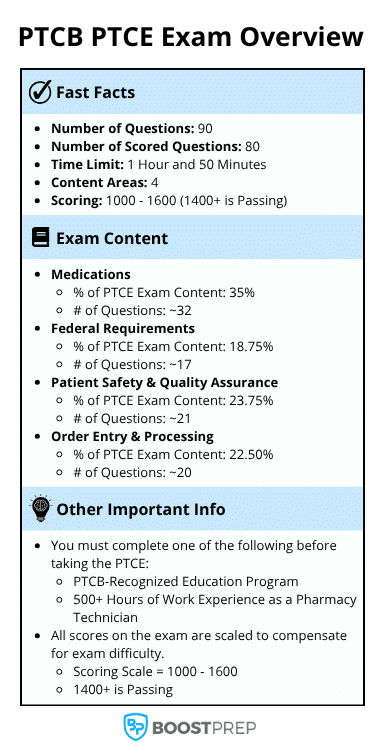
Fast Facts
Here are the fast facts for the exam:
- Format: Computer-Based
- Number of Questions: 90
- Number of Scored Questions: 80
- Time Limit: 2 Hours
- Pre/Post Test: 10 Minutes
- Actual Test: 1 Hour and 50 Minutes
- Content Areas: 4
- Scoring: 1000 – 1600
- Passing Score: 1400+
Exam Content
The Pharmacy Technician Certification Exam covers 4 main content areas known as “Domains”:
- Medications (35%)
- (1.1): Generic names, brand names, and classifications of medications
- (1.2): Therapeutic duplications
- (1.3): Common or life-threatening drug interactions and contraindications
- (1.4): Strengths/doses, dosage forms, routes of administration, special handling and
administration instructions, and duration of drug therapy - (1.5): Common or severe medication side effects, adverse effects, and allergies
- (1.6): Indications of medications
- (1.7): Drug stability
- (1.8): Proper storage of medications
- Federal Requirements
- (2.1): Federal requirements for storage, handling, and disposal of non-hazardous, hazardous, and pharmacological substances and wastes
- (2.2): Federal requirements for controlled substance prescriptions
and DEA controlled substance schedules - (2.3): Federal requirements for receiving, storing, ordering, labeling, dispensing, returning,
take-back programs for, loss or theft of, and destroying controlled substances - (2.4): Federal restricted drug programs and related medication-processing requirements
- (2.5): FDA requirements for medication recalls
- (2.6): FDA product serialization, tracking, tracing, handling, and quarantining requirements
- Patient Safety & Quality Assurance
- (3.1): High-alert/risk medications and look-alike/sound-alike (LASA) medications
- (3.2): Error prevention strategies
- (3.3): Issues that require pharmacist intervention
- (3.4): Event reporting procedures
- (3.5): Types of prescription errors
- (3.6): Infection prevention procedures and cleaning standards
- Order Entry & Processing
- (4.1): Formulas, calculations, ratios, proportions, conversions, Sig codes and abbreviations
- (4.2): Equipment and supplies required for drug administration
- (4.3): Lot numbers, expiration dates, and National Drug Code (NDC) numbers
- (4.4): Procedures for identifying and returning dispensable, non-dispensable, and expired
medications and supplies
Note: We cover all of these topics in our online PTCE prep course.
Pharmacy Technician Certification Exam Eligibility
Before taking the PTCE, you’ll need to meet one of the PTCB’s eligibility requirements. Most candidates qualify through either an approved training program or work experience.
- Option 1: Complete a PTCB-Recognized Education/Training Program (or be within 60 days of completion). The PTCB currently recognizes more than 1,400 approved programs.
- Option 2: Gain at least 500 hours of pharmacy technician work experience. This option allows experienced pharmacy technicians to qualify for certification without completing a PTCB-Recognized training program. Experience from a variety of pharmacy settings may be accepted.
PTCE Exam Scoring
PTCE Score Range
The PTCE uses a scaled scoring system that ranges from 1000 – 1600.To pass the exam, you will need to score 1400+.
The scaled score is not the percentage of questions you answered correctly. Instead, it is your raw score converted into a scaled score which takes into account differences in difficulty between different versions of the exam.
There is no exact percentage correct that equals a passing score of 1,400 on the PTCE. Because the exam uses scaled scoring, the number of questions needed to pass can vary. As a general benchmark, many candidates aim for 70% or higher on practice exams.
Scored Questions
There are 90 total questions (multiple-choice) on the PTCE. However, only 80 questions count towards your score.
The other 10 questions are used as experimental questions by the test-makers. You will not know which questions are scored or unscored, so it is important to answer all questions to the best of your abilities.
Getting Your Score / Retakes
You will receive a pass/fail result at the testing center following your exam. However, this is not considered “official.”
Your official score report will be accessible in your PTCB account, which typically takes 2-3 weeks. This score report will include the following:
- Scaled Score
- Scoring Information for Each of the 4 Domains
You can retake the PTCE if necessary. However, keep these items in mind:
- First & Second Retakes: You will have to wait for at least 60 days before retesting.
- Third Retake: You will have to wait for 6 months before retesting.
- Fourth Retake: You will have to submit proof of proper preparation to the PTCB before retesting.
PTCE Study Strategies
The PTCE can be overwhelming to study for. Review our recommended tools, tips, and tricks below to help study more efficiently and ensure you pass your exam.
Study Tools
Some of the best study tools you can use when preparing for the PTCE include:
- High-Yield Learning Content: The key is to not get “into the weeds.” There is a lot of content knowledge needed for this exam. Make sure you find a resource that highlights the most important items and keeps you on track.
- Flashcards: Flashcards are especially helpful for the medications domain. Reviewing 10-20 medications flashcards is a great way to learn content without overwhelming yourself.
- Simulated Exams: Taking a simulated exam will help you become more comfortable with the types of questions, types of content, and timing of the actual exam. Make sure to take some form of a simulated exam before the actual exam so you are not going in blind.
Benefits of Practice Questions
PTCE practice questions are very beneficial. Some of the most important benefits of using practice questions are:
- Get a Baseline: Using practice questions will help you narrow down which domains you should focus your studies on. Take one of our free PTCE practice tests above to get started.
- Answer Explanations: You can use the answer explanations to learn key concepts. Allocating time to reviewing your answer explanations will be very beneficial in the long-run.
- Familiarity: The more questions you answer, the more familiar you will become with the actual exam. This will help you when test day comes around.
Tips and Tricks for PTCE Practice
Here are some tips and tricks to keep in mind when preparing for the pharmacy technician certification exam:
- Take a Diagnostic Exam: Taking a diagnostic exam will help you narrow down which domains you need to focus on. Take our PTCE practice exam above to get started. We also offer a more in-depth diagnostic exam in our course.
- Review Answer Explanations: Many students will take an exam, finish the exam, then move on. Make sure to allocate time for reviewing your answer explanations. At the bare minimum, make sure to review the questions you answered incorrectly.
- Answer Incorrect Questions: Go back and answer questions that you had previously answered incorrectly. We call this a “challenge bank”. This is a great way to ensure you learned a concept.
Note: We offer all of these study tools and more in our PTCB PTCE prep course.
